
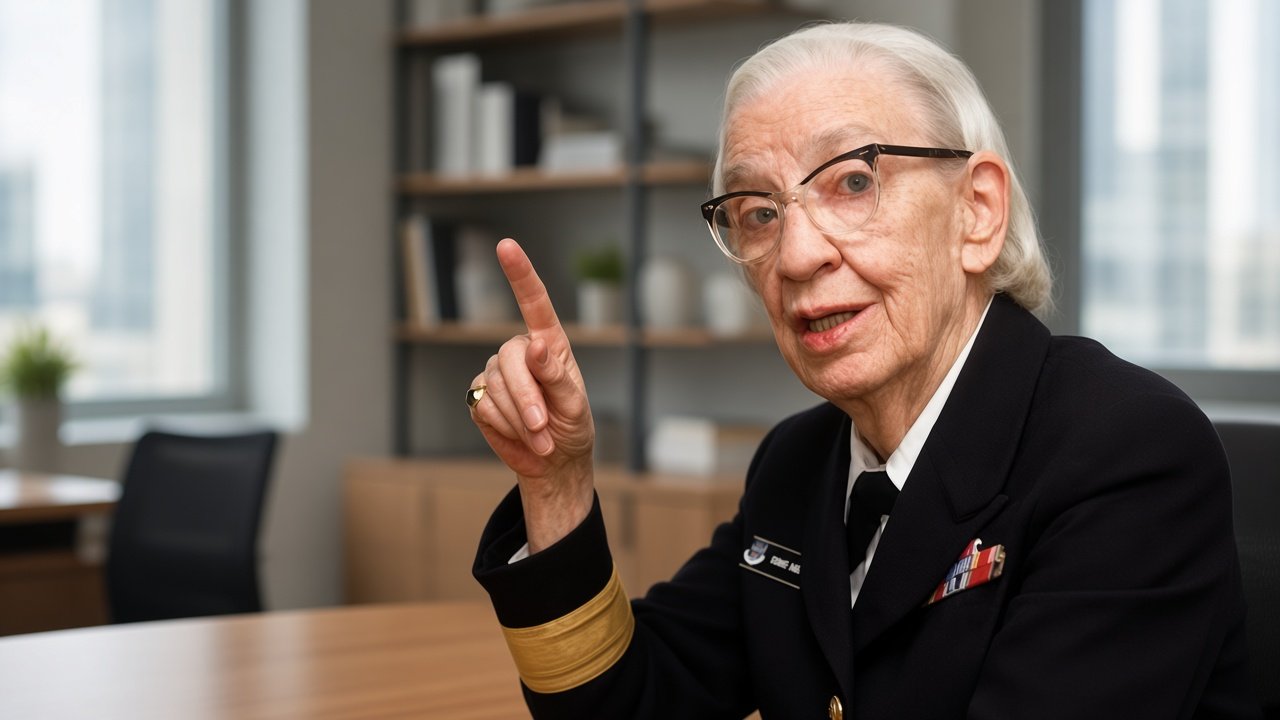
Grace Hopper was a mathematician, a computer scientist and a United States Navy admiral. She helped computers become easier to use, and she did it at a time when most people thought they were only for experts. Her story offers many life lessons from Grace Hopper that we can use today.
This article explains who she was and six lessons from her remarkable career.
Who Was Grace Hopper?
Grace Hopper (born Grace Brewster Murray) was born on December 9, 1906, in New York City. She earned a Ph.D. in mathematics from Yale University and taught mathematics before World War II.
In 1943, she joined the US Navy. She was assigned to work on the Harvard Mark I, one of the earliest large computers, and became one of its first programmers.
After the war, she worked on the UNIVAC computer. By 1952, she had finished a program called the A-0 system, which is considered one of the first compiler-related tools. A compiler translates instructions that humans can read into code that a machine can run.
She died on January 1, 1992, at the age of 85.
Her Biggest Achievements
- Early compiler work: her A-0 system turned mathematical notation into machine code.
- FLOW-MATIC: her team developed this early programming language that used English-like words.
- COBOL: she did not invent it alone, but she helped shape it and promoted it. It was designed to be based on English words and to work on different machines.
- Navy career: she served from 1943 to 1986, and retired as a rear admiral at age 79, as the oldest serving officer.
- Awards: she received the National Medal of Technology in 1991, and the Presidential Medal of Freedom after her death in 2016.
6 Life Lessons From Grace Hopper
1. Stay Curious
Hopper was very curious as a child, and that trait stayed with her for life. She asked how things worked and kept learning new fields, from mathematics to computing.
The lesson: Curiosity is a skill. The more questions you ask, the more doors you open.
2. Make Hard Things Simple
Early computers needed instructions in numbers and machine code, which only a few experts understood. Hopper believed programming could use words closer to normal English. This idea led to FLOW-MATIC and helped inspire COBOL.
The lesson: Good teachers and good creators make complicated things easier to understand.
3. Build the Tool You Need
When there was no easy way to write programs, Hopper helped create one. Her compiler saved time and reduced mistakes, so more people could use computers.
The lesson: If you cannot find the right tool, think about making it. Many great inventions start as someone’s solution to their own problem.
4. Question “We Have Always Done It This Way”
Hopper pushed for machine-independent programming languages, which was a new idea at the time. Many people doubted that computers could understand anything close to English.
The lesson: A habit is not always a good reason. Ask whether there is a better way, and be ready to explain your idea clearly.
5. Keep Learning and Serving
Hopper retired from the Navy Reserve in 1966, but the Navy called her back in 1967, when she was 60. She served for almost twenty more years before retiring in 1986.
The lesson: Age does not limit usefulness. Skills and experience stay valuable when you keep learning.
6. Invest in People
When she received the National Medal of Technology in 1991, Hopper said that the young people she had trained were what she was most proud of. She felt this mattered even more than writing the first compiler.
The lesson: Your work can last beyond you if you teach others. Share what you know and help them grow.
When “Computers” Were People
Before electronic machines were common, the word “computer” often meant a person who did calculations by hand. Hopper’s career straddled both worlds. Around the same period, mathematicians like Katherine Johnson worked as human computers at NASA’s predecessor.
The ideas behind programming go back even further. A century earlier, Ada Lovelace wrote about how a machine could follow a set of instructions. Hopper helped turn that dream into practical tools.
Her Legacy
The Navy named a destroyer, the USS Hopper, in her honor. She is also remembered every year by the Grace Hopper Celebration, which supports women in technology.
For a detailed biography, you can visit Britannica’s page on Grace Hopper.
Frequently Asked Questions
Did Grace Hopper invent COBOL?
Not by herself. She helped shape the ideas behind it and encouraged its use. COBOL was created by a group of experts in 1959.
What is Grace Hopper famous for?
She is famous for her work on early compilers, her role in making programming languages easier to use, and her long Navy career.
When did Grace Hopper die?
She died on January 1, 1992, at the age of 85.
What rank did Grace Hopper reach in the Navy?
She became a rear admiral, and she retired in 1986.
Conclusion
Grace Hopper’s life teaches us to stay curious, make difficult things simple, build useful tools, question old habits, keep learning and help others grow.
Pick one of these life lessons from Grace Hopper and try it this week. Small steps can lead to big changes.