
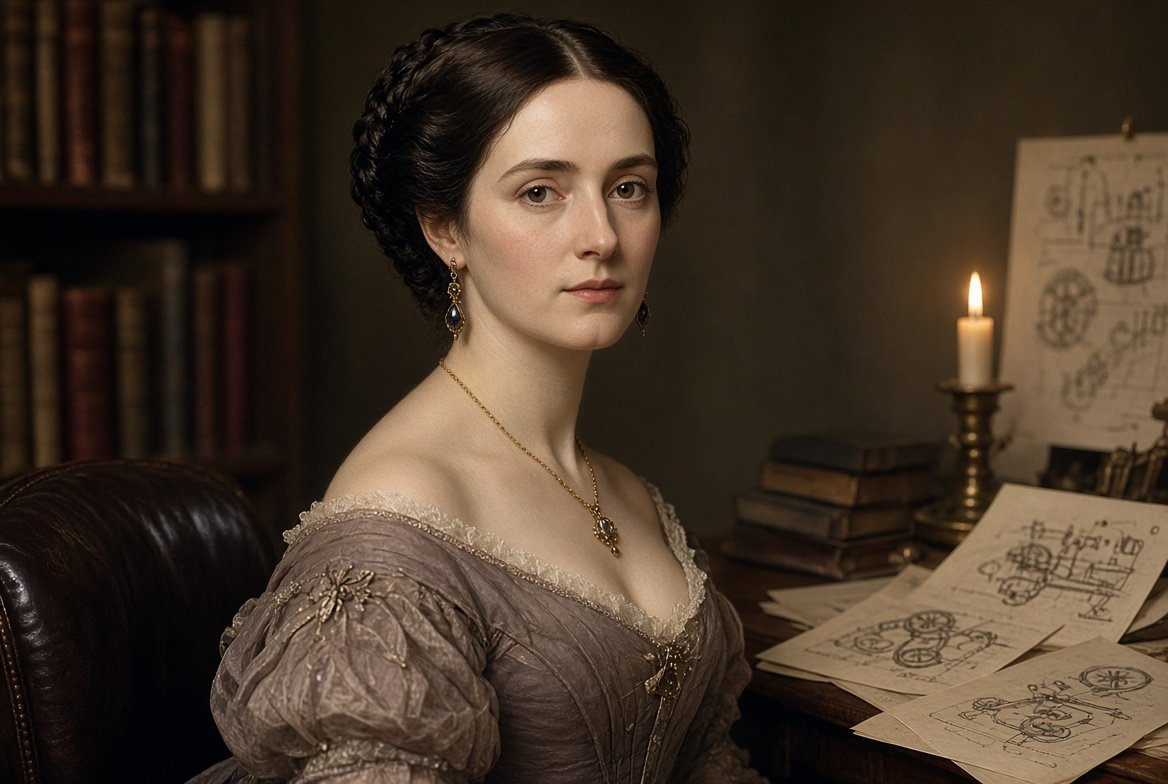
Long before the first modern computer was built, one young woman imagined what such machines could do. So, who was Ada Lovelace and why does she matter? She was a 19th-century mathematician whose notes on an early computing machine are still studied today.
This guide explains her life and her legacy in simple words.
Who Was Ada Lovelace?
Ada Lovelace was born Augusta Ada Byron on December 10, 1815, in London. Her father was the famous poet Lord Byron. He left England when she was a baby, and she never really knew him.
Her mother, Annabella Milbanke, made sure Ada studied mathematics and science from an early age. In 1835, Ada married William King, who later became the Earl of Lovelace. That is how she became the Countess of Lovelace.
Her Friendship With Charles Babbage
In 1833, her tutor Mary Somerville introduced her to Charles Babbage, a mathematician and inventor. Babbage had designed a mechanical calculator called the Difference Engine. He was also planning a more advanced machine called the Analytical Engine.
The Analytical Engine was meant to be a general-purpose machine. It would use punched cards to follow instructions. This is a bit like how modern computers follow programs.
Ada became fascinated by Babbage’s work, and the two became friends. Babbage called her the “Enchantress of Number”.
The 1843 Notes
In 1842, Ada translated an article about the Analytical Engine from French into English. The article was written by Italian engineer Luigi Menabrea.
She did not just translate it. She added her own notes, labeled A to G. Together, her notes were much longer than the original article. They were published in 1843.
Note G and the Bernoulli Numbers
In Note G, Ada described a step-by-step method for the machine to calculate a series of numbers called Bernoulli numbers.
Many people call this the first published computer program. The Analytical Engine was never built, so her method was never run on the machine.
Her Big Idea: Computers Can Do More Than Math
Ada saw something that many people at the time missed. She suggested that the machine might work with more than numbers. If music and sounds could be described using rules, she said, the engine might even compose music.
Today we use computers for music, pictures, writing and video. Ada’s idea was far ahead of her time.
Was Ada Lovelace the First Programmer?
This is a topic that historians discuss. Here is the fair summary:
- Charles Babbage had written some earlier sample programs for his machine.
- Ada worked closely with Babbage, and he reviewed her work.
- Ada’s Note G is still seen as the first published algorithm made for a computer, and her writing showed a deep understanding of what the machine could do.
Because of this, she is often called the first computer programmer. Some historians prefer to describe her as the first person to clearly explain the potential of computing. You can read more in a biography from the University of St Andrews.
Her Later Life and Death
Ada had health problems for much of her life. She died on November 27, 1852, at the age of 36, from cancer. At her request, she was buried next to her father.
Her notes were largely forgotten, until they were republished in 1953. Interest in her work has grown ever since.
Why Ada Lovelace Matters Today
- She imagined modern computing. Her ideas reached beyond simple calculation.
- She joined art and science. She described her way of thinking as “poetical science”.
- She inspires women in technology. Ada Lovelace Day is held every October to celebrate women in science and technology.
- A programming language carries her name. The US Department of Defense named the Ada language after her.
More Inspiring Stories
If you enjoy stories about pioneers in math and technology, read life lessons from Katherine Johnson and what we can learn from Dorothy Vaughan.
Frequently Asked Questions
Was Ada Lovelace really the first computer programmer?
She is widely called that because of her published algorithm in Note G. Some historians point out that Babbage had written earlier sample programs, so the title is debated.
Did the Analytical Engine ever get built?
No. Babbage never finished it, mainly because of money problems. That means Ada’s program was never run on the real machine.
How old was Ada Lovelace when she died?
She was 36 years old.
Who was Ada Lovelace’s father?
Her father was the poet Lord Byron.
Conclusion
So, who was Ada Lovelace and why does she matter? She was a gifted mathematician who understood early on that machines could do far more than add numbers.
Her short life reminds us that curiosity, imagination and careful thinking can shape the future, even when the technology does not exist yet.