
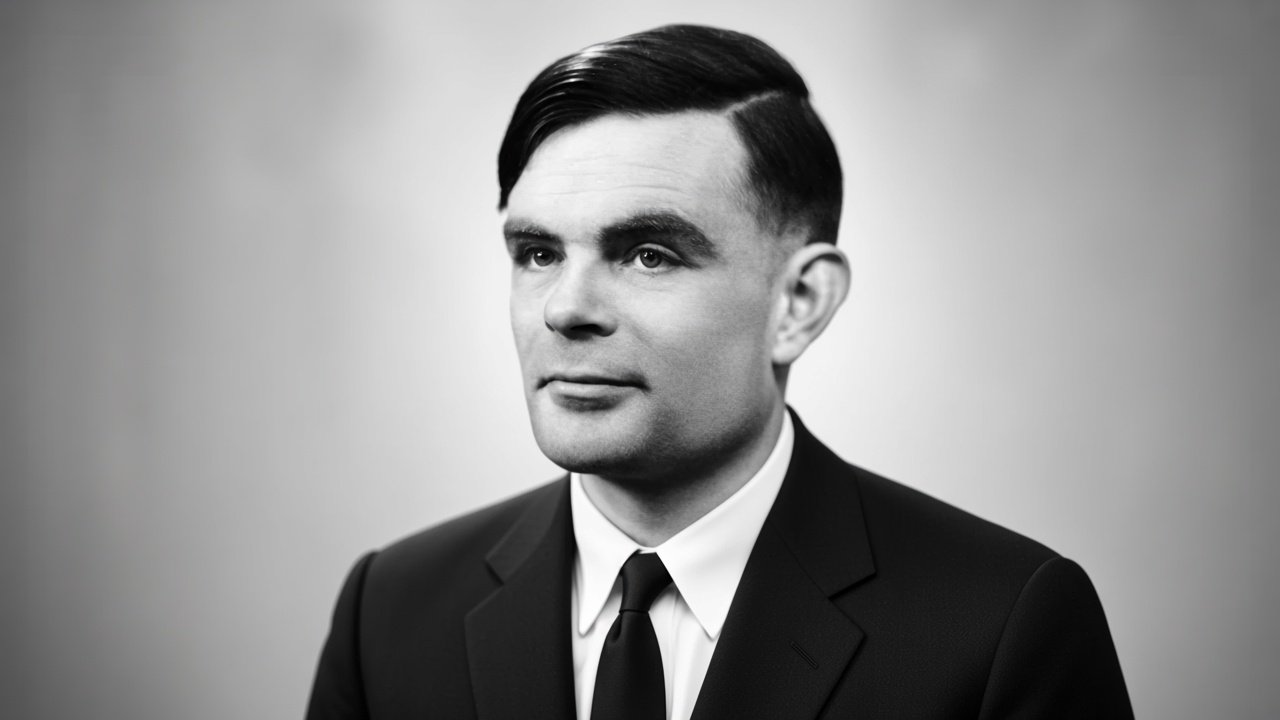
Alan Turing was a British mathematician whose ideas helped shape modern computers and artificial intelligence. During World War II, he also helped break secret German codes. So, who was Alan Turing and why does he matter?
This guide explains his life, his work and his legacy in simple words, including the unfair way he was treated.
Who Was Alan Turing?
Alan Turing was born on June 23, 1912, in London. He showed a natural talent for mathematics and science from a young age.
He studied at Cambridge University. In 1936, he published a famous paper that described an imaginary machine, later called the “Turing machine”. It explained, in a mathematical way, what a computer could and could not do. Many people see it as a foundation of computer science.
Turing at Bletchley Park
When World War II began, Turing joined the Government Code and Cypher School at Bletchley Park, in England. Its job was to read secret German messages.
The Germans used a machine called Enigma to scramble their messages. Turing worked on breaking the German naval Enigma, which helped the Allies track U-boats in the Atlantic.
With colleague Gordon Welchman, he helped design a machine called the Bombe. It built on earlier work by Polish codebreakers and made decoding much faster.
Historians believe codebreaking at Bletchley Park shortened the war and saved many lives. The exact size of that effect is difficult to measure. Because the work was secret, the public did not learn about it until decades later.
Can Machines Think?
After the war, Turing worked on early computer designs, including the ACE (Automatic Computing Engine).
In 1950, he published a paper called “Computing Machinery and Intelligence”. It begins with the question, “Can machines think?” He suggested a practical test, which he called the “imitation game”. Today it is known as the Turing test. In it, a person chats with a hidden partner and tries to tell whether it is a human or a machine.
In the same paper, he answered an objection that goes back to Ada Lovelace, who had written that a machine can only do what we know how to order it to do. Turing argued that machines might still surprise us.
How Turing Was Treated
In the 1950s, homosexuality was a crime in Britain. In 1952, Turing was convicted of “gross indecency” for a relationship with another man.
He was given a choice between prison and a hormone treatment, often called chemical castration. He chose the treatment. His conviction also removed his security clearance, so he could no longer work for the government’s communications agency, GCHQ.
Turing died in June 1954 at the age of 41, from cyanide poisoning. An inquest recorded a verdict of suicide. His mother and some others always believed his death was an accident.
Apology and Pardon
- In 2009, British Prime Minister Gordon Brown apologized for the “appalling way” Turing was treated.
- In 2013, Queen Elizabeth II granted him a posthumous royal pardon.
- A later law, informally called “Turing’s Law”, extended pardons to other men convicted under the same old laws.
Turing’s Legacy
- The Turing Award: since 1966, the Association for Computing Machinery has given this award, often called the “Nobel Prize of computing”.
- The £50 note: in 2021, the Bank of England issued a new £50 note with his portrait, on what would have been his birthday.
- Artificial intelligence: his questions about machine thinking are still discussed today.
You can read more about his life and the new banknote in Smithsonian Magazine.
Why Alan Turing Matters Today
- He helped lay the foundation of computing. His 1936 paper is still taught in computer science.
- He asked questions we still ask. Can machines think? What does it mean to be intelligent?
- His story is a warning. It shows how prejudice can harm people and waste talent.
Frequently Asked Questions
What did Alan Turing invent?
He did not invent the modern computer on his own. He created the idea of the Turing machine, helped design the Bombe, worked on early computer designs and proposed the Turing test.
What is the Turing test?
It is a test of whether a machine can hold a conversation so well that a person cannot tell it from a human.
How old was Alan Turing when he died?
He was 41 years old.
Why was Alan Turing pardoned?
He was convicted under a law that criminalized homosexuality. That law is now seen as unjust, and the British government pardoned him in 2013.
Conclusion
Alan Turing was a brilliant mathematician who helped win a war and laid the groundwork for modern computing. He also suffered from unfair laws.
So, who was Alan Turing and why does he matter? He reminds us to ask big questions, and to treat people fairly.