
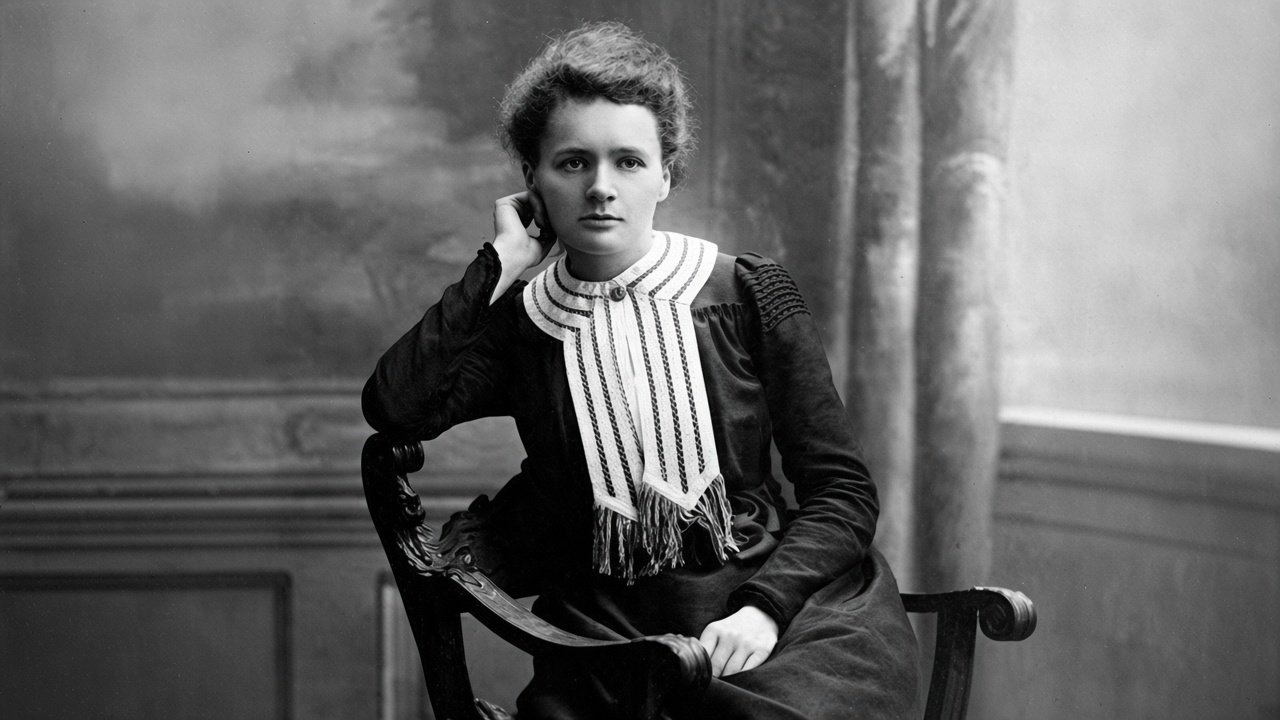
Marie Curie was a physicist and chemist who changed our understanding of radioactivity. She was the first woman to win a Nobel Prize, and the first person to win it twice. Her story offers many life lessons from Marie Curie about hard work, courage and using knowledge to help others.
This article explains who she was and five lessons we can learn from her life.
Who Was Marie Curie?
Marie Curie was born Maria Skłodowska on November 7, 1867, in Warsaw, which was then part of the Russian Empire. She came from a family of teachers who believed strongly in education.
She moved to Paris to continue her studies. There, she met the French physicist Pierre Curie, who became her husband and research partner. They married in 1895.
Her Scientific Achievements
- Radioactivity: she coined this term while studying the rays given off by certain materials.
- New elements: with Pierre, she discovered polonium and radium. Polonium was named after her home country, Poland.
- 1903 Nobel Prize in Physics: she shared it with Pierre Curie and Henri Becquerel.
- 1911 Nobel Prize in Chemistry: she won it alone for her work on radium and polonium.
She was the first woman to win a Nobel Prize, the first person to win two, and the only person to win in two different scientific fields. You can read the official facts on the Nobel Prize website.
Loss and Work During War
In 1906, Pierre Curie died in a street accident in Paris. Marie continued their work, and she became the first woman professor at the University of Paris.
During World War I, she helped set up mobile X-ray units, known as “little Curies”, so doctors could find bullets and broken bones in wounded soldiers near the front lines. She also donated her gold Nobel medals to support the war effort.
Her Death and Legacy
Marie Curie died on July 4, 1934, at the age of 66. The cause was aplastic anemia, which is believed to be linked to years of radiation exposure from her research and her work with X-ray units.
In 1995, she became the first woman to be laid to rest in the Panthéon in Paris on her own merits. Her family also carried on her legacy: her daughter Irène Joliot-Curie won a Nobel Prize in Chemistry in 1935, together with her husband.
5 Life Lessons From Marie Curie
1. Do Not Let Barriers Stop Your Education
In the Poland where Curie grew up, women were not allowed to attend university. She found other ways to study, then moved to Paris so she could study science.
The lesson: If one door is closed, look for another. Learning is worth the effort.
2. Hard Work Beats Quick Wins
Discovering radium meant processing huge amounts of raw material, by hand, for years. The work was slow and physically hard.
The lesson: Big results often come from patient, steady work, not from shortcuts.
3. Keep Going After a Loss
When Pierre died, Curie could have stopped. Instead, she continued their research, took over his teaching post and went on to win a second Nobel Prize.
The lesson: Grief is real, and it is okay to feel it. Meaningful work can help you move forward.
4. Use Your Skills to Help Others
When the war began, Curie did not stay in her laboratory. She used her knowledge to help doctors save lives with X-rays.
The lesson: Knowledge is most valuable when it serves other people.
5. Respect the Risks of Your Work
In Curie’s time, the dangers of radiation were not understood. Her notebooks are still radioactive today and are kept in special storage.
The lesson: Pioneers often work with unknown risks. Today, we should follow safety rules and protect each other, especially when working with new technology.
Marie Curie and X-Rays Today
X-rays are still used in hospitals, and scientists also use X-ray methods to study molecules. For example, Rosalind Franklin used X-ray diffraction to study DNA decades later.
The story shows how one generation of scientists builds on the work of the last.
Frequently Asked Questions
What is Marie Curie famous for?
She is famous for her research on radioactivity, for discovering polonium and radium, and for winning two Nobel Prizes.
Did Marie Curie win two Nobel Prizes?
Yes. She won the Nobel Prize in Physics in 1903 and the Nobel Prize in Chemistry in 1911.
How did Marie Curie die?
She died of aplastic anemia in 1934, which is believed to be linked to long-term radiation exposure.
Why was Marie Curie important in World War I?
She helped create mobile X-ray units that allowed doctors to treat wounded soldiers.
Is Marie Curie the only person to win Nobel Prizes in two sciences?
Yes. She is the only person to have won a Nobel Prize in two different scientific fields.
Conclusion
Marie Curie’s life teaches us to keep learning despite barriers, to value patient hard work, to keep going after loss, to use knowledge to help others and to respect risk.
Pick one of these life lessons from Marie Curie and use it this week. A small step toward learning something new is a good place to start.